Our story
How one idea grew into an interconnected ecosystem for MS research.
It started with a determination to move MS research faster.
Accelerated Cure Project for MS (ACP) was founded in 2001 by a person living with MS who believed research could move faster if some of the barriers that slow it were removed.
At the time, MS research data, biological samples, and knowledge tended to sit siloed within individual institutions or studies. ACP set out to change that. The idea was simple but ambitious: make valuable research resources more widely available so scientists could build on existing knowledge and pursue new discoveries.
That vision became the foundation for the ACP Repository.
Building a resource that could keep giving
People affected by MS contributed biosamples and detailed health information to create a resource that could support not just one study, but many.
Today, the ACP Repository includes biosamples and extensive health data from more than 3,200 participants. As science advances, those contributions continue to create value. A sample collected years ago can be studied using technology that didn’t exist when it was given. Data generated by one study can open new possibilities for another.
But as ACP grew, so did our understanding of what research was missing.
Research needed more than samples and data
The experiences of people affected by MS weren’t always reflected in the questions being asked or the way research was designed.
So ACP expanded the idea of what a shared research resource could be.

In 2015, ACP launched iConquerMS, a research network built with and around the MS community. Through iConquerMS, people affected by MS gained new ways to share their experiences, participate in studies, identify research priorities and work with researchers to shape what gets studied and how.
Today, more than 10,000 people are part of iConquerMS. And through longitudinal research such as REAL-MS, experiences shared over time are creating data that can reveal patterns that may not be visible in a clinic visit or a single study.
Bringing more people into research also made something else clear: who participates matters.
Making research more representative
Some communities have long been underrepresented in MS research, including certain racial and ethnic groups, older adults and those living in rural areas. Barriers such as mobility challenges, transportation costs, distance from research centers and restrictive eligibility requirements can further limit participation.
These gaps matter. When studies draw from a subset of the MS population, what they find may not hold true for everyone else living with MS.
ACP began working more intentionally to understand and address these barriers, from awareness and access to study design and eligibility.
In 2016, ACP established the MS Minority Research Engagement Partnership Network (MREPN), bringing together people affected by MS, researchers, healthcare providers and other partners to identify barriers to participation and develop practical ways to address them.
That commitment grew with the Research Inclusion, Diversity and Equity (RIDE) Council, a group of people living with MS from historically underrepresented communities who draw on their experiences to help shape research priorities, study design and recruitment.
Together, these initiatives give researchers the community perspectives, relationships and practical tools to make inclusion part of research from the beginning.
One idea kept growing
ACP’s work didn’t grow as separate answers to separate problems. Each part strengthens the others: a research community, the data and biosamples it contributes, and the inclusion that makes the science more representative.
Together, they have become a research ecosystem that helps speed discovery.
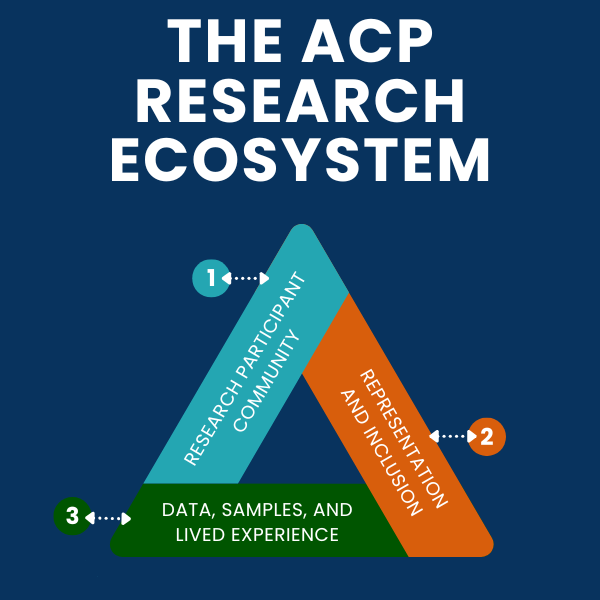
A question raised by someone affected by MS can lead researchers in a new direction. Years of participant-reported data can reveal a pattern no one had seen before. A biosample collected years ago can yield new information when a new technology becomes available. Perspectives that were once missing can change how a study is designed. And what one study learns can become something the next researcher can build on.
It’s the same idea that inspired ACP 25 years ago, now made possible on a much larger scale: connecting people, data, samples and expertise so research can move faster and answers can come sooner.